Add Receipt
WhiteBooks records customer payments against invoices with complete accuracy. Each receipt captures the payer, invoice reference, amount, payment details, and date—ensuring revenue is correctly applied and instantly reflected in the books.
Every receipt is recorded with a system-generated receipt identifier, customer identity, linked invoice reference number, exact amount received, payment mode and instrument details, and the associated transaction reference number — creating a complete and traceable record for every customer payment collected by the organization.
WhiteBooks automatically links each receipt to the corresponding outstanding invoice at the time of recording. This instantly updates the invoice’s outstanding balance, marks fully settled invoices as paid, and maintains a clear partial payment trail for invoices where customers remit only a portion of the total amount due.
Every receipt entry is simultaneously posted to the appropriate accounts receivable and cash or bank ledger accounts in real time — reducing debtor balances, updating account balances, and reflecting the collection immediately in the organization’s financial records without requiring manual journal entries.
Receipt Register
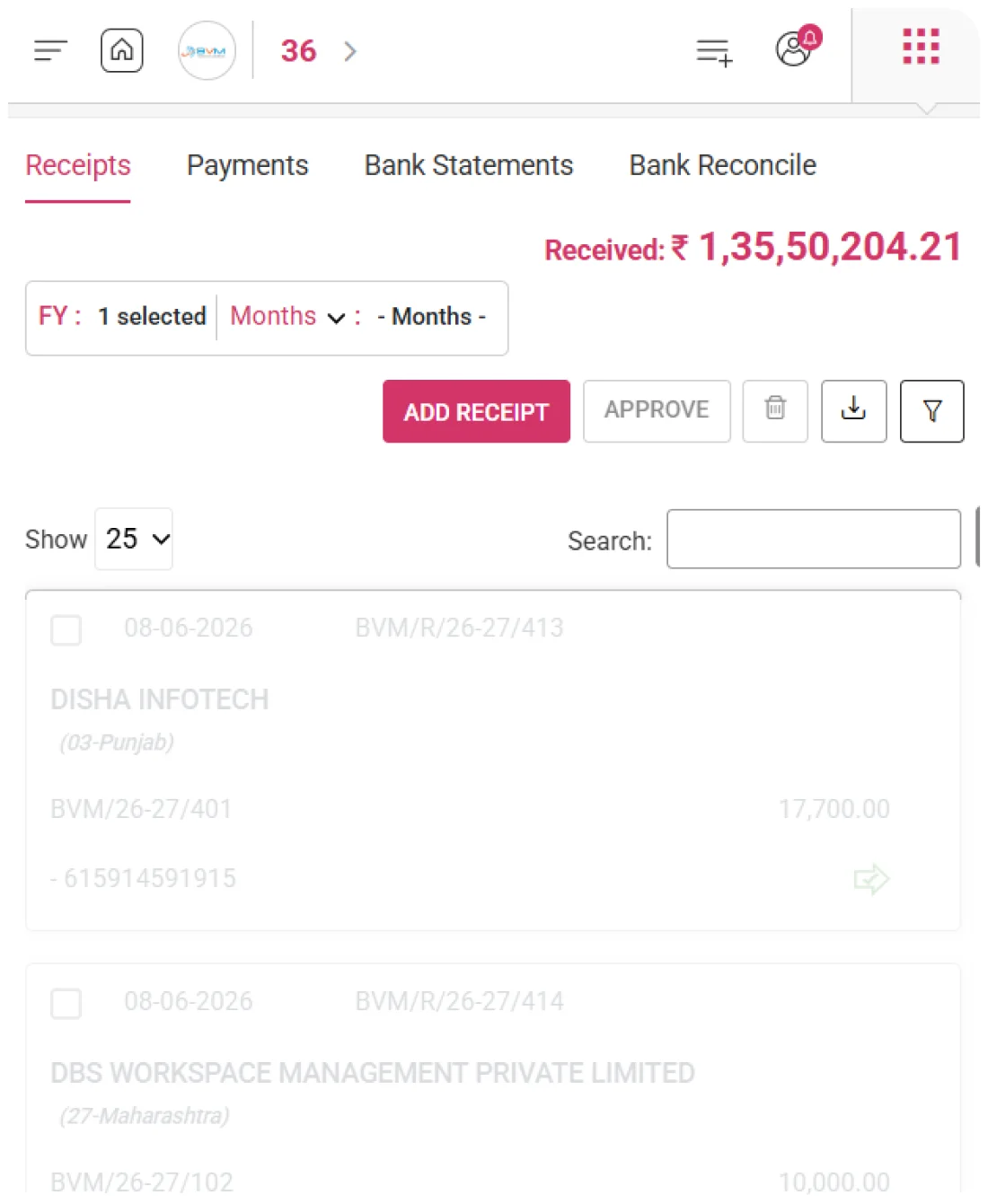
WhiteBooks maintains a structured receipt register displaying every customer payment in the selected period with date, system ID, customer, invoice reference, amount, and external reference—ensuring collection visibility and accurate debtor reconciliation.
Each receipt entry is displayed with its Date, Receipt ID, Party Name, Invoice Number, Amount Received, and Reference Number in a structured register — allowing accounts receivable teams and auditors to quickly review or verify customer payments without opening individual receipt records for basic transaction details.
The Invoice Number column establishes a direct connection between every receipt and its corresponding sales invoice, enabling finance teams to instantly verify settled invoices, identify partially paid invoices, and review the full payment history of any customer account.
Every receipt includes the customer’s external payment reference — such as a bank transfer reference number, cheque number, or payment gateway transaction ID — creating a traceable link between the internal receipt record and the customer’s payment evidence for dispute resolution, bank reconciliation, and audit verification.
Financial Period Management
WhiteBooks scopes the entire receipts workspace to a specific financial year and selected months — ensuring that all collection records, received totals, and invoice settlement statuses displayed are strictly relevant to the chosen timeframe.
The receipts workspace operates within the boundaries of the active financial year, ensuring that all collection records, debtor settlement summaries, and revenue analyses remain aligned with statutory reporting cycles and annual financial statement preparation.
Users can select individual months or a range of months within the financial year to focus the receipt register on a defined collection window, enabling targeted cash flow analysis, month-wise collection performance reviews, and period-specific debtor reconciliation directly within the workspace.
Finance teams can switch between financial years and months to compare collection trends, identify unusual payment activity, and reconcile historical receipts with bank statements and debtor ledgers for accurate accounts receivable tracking.
Collection Summary
WhiteBooks tracks total customer payments within the active period, giving finance teams a real-time collection view for cash flow monitoring and financial oversight before period-end reporting.
The total amount received from all customer payments within the active period is automatically calculated and displayed in real time, allowing stakeholders to instantly view cumulative collections without generating separate accounts receivable reports.
The cumulative received amount acts as a real-time measure of revenue realization, enabling finance teams to compare actual collections against outstanding receivables, evaluate credit control effectiveness, and monitor overall collection efficiency across the selected period.
Any addition, modification, or deletion of a receipt entry automatically triggers a recalculation of the period’s total received value, ensuring the collection summary always reflects the most accurate and up-to-date record of all confirmed customer payments.
Invoice Payment Tracking
WhiteBooks tracks sales invoice settlement through receipt linkage, giving receivable teams a real-time view of paid, partial, and unpaid invoices. This ensures payments are applied correctly, prevents double-counting, and supports accurate debtor aging and receivable reporting.
Every receipt in the register displays its associated invoice number, enabling accounts receivable teams to instantly identify which invoices have been settled by a specific payment and verify that each customer collection has been correctly applied to its corresponding billing document.
WhiteBooks tracks partial payments against invoices by automatically calculating and displaying the remaining balance after each receipt. This ensures accurate receivable records and prevents invoices from closing before full payment is received.
The aggregation of invoice settlements within the active period reflects the organization’s receivable realization position, helping finance managers evaluate collections against billings and identify outstanding receivable balances.
Reference Tracking
WhiteBooks captures and stores the external payment reference for every customer receipt, creating a permanent, traceable link between the internal receipt record and the customer’s payment documentation.
Each receipt captures the customer’s external payment reference—UTR, cheque, NEFT/RTGS, or payment gateway ID—creating a permanent link between the WhiteBooks record and the corresponding bank or gateway entry.
The stored external reference allows direct matching of WhiteBooks collection records to bank statements during monthly reconciliation, eliminating manual cross-checks and significantly reducing reconciliation time.
When customers dispute a payment, the external payment reference stored in WhiteBooks lets finance instantly locate and verify the transaction, providing documented proof and enabling rapid dispute resolution without lengthy investigation.
Receipt Retrieval
WhiteBooks allows instant retrieval of any receipt—by customer, receipt ID, invoice, or external reference—eliminating manual searches and enabling finance teams to resolve queries, reconcile banks, and perform audits efficiently.
Every character entered into the search query instantly narrows the receipt register in real time, allowing accounts receivable teams to locate the required customer payment record within seconds without manually scanning through extensive lists of collection entries in the active period.
Retrieval queries match simultaneously across Receipt ID, Party Name, Invoice, Amount, and External Reference, enabling finance teams to locate any customer payment record regardless of which detail they recall.
All retrieval results are scoped to the active financial year and selected month(s), ensuring records remain contextually relevant and preventing unrelated historical entries from causing confusion or errors during reconciliation.
Export
WhiteBooks lets finance teams export the complete receipt dataset for the active period in a structured, portable format. This supports reconciliation, reporting, audits, and period-wise collection archiving—fully accessible beyond WhiteBooks.
All receipts within the active period are extracted in a single operation — producing a structured output containing every register column, including Date, Receipt ID, Party, Invoice Number, Amount Received, and Reference Number. The dataset is immediately ready for accounts receivable reconciliation, cash flow reporting, and collection performance analysis without additional formatting.
The exported dataset is structured for direct use in financial analysis applications. Finance teams can build party-wise collection analyses, invoice settlement rate reports, month-wise revenue realization summaries, and bank reconciliation worksheets for management review, board presentations, and credit control strategy development.
Downloaded receipt records constitute complete documentary evidence of all customer collections in the period. This supports statutory audit requirements, income tax assessments, GST output liability verification, bank reconciliation documentation, and internal financial governance reviews, providing verified proof of every payment received by the organization.
Get started with WhiteBooks
WhiteBooks ensures receipts are traceable and reconciled with accurate invoice settlements and payment references for audit ready accounts receivable.
No Credit Card Required
Receipt Register
Centralized Collection Register
WhiteBooks maintains a structured receipt register displaying every customer payment in the selected period with date, system ID, customer, invoice reference, amount, and external reference—ensuring collection visibility and accurate debtor reconciliation.
Collection Overview
Each receipt entry is displayed with its Date, Receipt ID, Party Name, Invoice Number, Amount Received, and Reference Number in a structured register — allowing accounts receivable teams and auditors to quickly review or verify customer payments without opening individual receipt records for basic transaction details.
Invoice–Receipt Tracking
The Invoice Number column establishes a direct connection between every receipt and its corresponding sales invoice, enabling finance teams to instantly verify settled invoices, identify partially paid invoices, and review the full payment history of any customer account.
External Reference Documentation
Every receipt includes the customer’s external payment reference — such as a bank transfer reference number, cheque number, or payment gateway transaction ID — creating a traceable link between the internal receipt record and the customer’s payment evidence for dispute resolution, bank reconciliation, and audit verification.
Receipt Register
Centralized Collection Register
WhiteBooks maintains a structured receipt register displaying every customer payment in the selected period with date, system ID, customer, invoice reference, amount, and external reference—ensuring collection visibility and accurate debtor reconciliation.
Collection Overview
Each receipt entry is displayed with its Date, Receipt ID, Party Name, Invoice Number, Amount Received, and Reference Number in a structured register — allowing accounts receivable teams and auditors to quickly review or verify customer payments without opening individual receipt records for basic transaction details.
Invoice–Receipt Tracking
The Invoice Number column establishes a direct connection between every receipt and its corresponding sales invoice, enabling finance teams to instantly verify settled invoices, identify partially paid invoices, and review the full payment history of any customer account.
External Reference Documentation
Every receipt includes the customer’s external payment reference — such as a bank transfer reference number, cheque number, or payment gateway transaction ID — creating a traceable link between the internal receipt record and the customer’s payment evidence for dispute resolution, bank reconciliation, and audit verification.
Get started with WhiteBooks
WhiteBooks ensures receipts are traceable and reconciled with accurate invoice settlements and payment references for audit ready accounts receivable.
No Credit Card Required
Add Receipt
Record Customer Payment Receipts
WhiteBooks records customer payments against invoices with complete accuracy. Each receipt captures the payer, invoice reference, amount, payment details, and date—ensuring revenue is correctly applied and instantly reflected in the books.
Complete Payment Receipt Capture
Every receipt is recorded with a system-generated receipt identifier, customer identity, linked invoice reference number, exact amount received, payment mode and instrument details, and the associated transaction reference number — creating a complete and traceable record for every customer payment collected by the organization.
Track Payments by Invoice
WhiteBooks automatically links each receipt to the corresponding outstanding invoice at the time of recording. This instantly updates the invoice’s outstanding balance, marks fully settled invoices as paid, and maintains a clear partial payment trail for invoices where customers remit only a portion of the total amount due.
Instant Revenue Ledger Integration
Every receipt entry is simultaneously posted to the appropriate accounts receivable and cash or bank ledger accounts in real time — reducing debtor balances, updating account balances, and reflecting the collection immediately in the organization’s financial records without requiring manual journal entries.
Add Receipt
Record Customer Payment Receipts
WhiteBooks records customer payments against invoices with complete accuracy. Each receipt captures the payer, invoice reference, amount, payment details, and date—ensuring revenue is correctly applied and instantly reflected in the books.
Complete Payment Receipt Capture
Every receipt is recorded with a system-generated receipt identifier, customer identity, linked invoice reference number, exact amount received, payment mode and instrument details, and the associated transaction reference number — creating a complete and traceable record for every customer payment collected by the organization.
Track Payments by Invoice
WhiteBooks automatically links each receipt to the corresponding outstanding invoice at the time of recording. This instantly updates the invoice’s outstanding balance, marks fully settled invoices as paid, and maintains a clear partial payment trail for invoices where customers remit only a portion of the total amount due.
Instant Revenue Ledger Integration
Every receipt entry is simultaneously posted to the appropriate accounts receivable and cash or bank ledger accounts in real time — reducing debtor balances, updating account balances, and reflecting the collection immediately in the organization’s financial records without requiring manual journal entries.
Get started with WhiteBooks
WhiteBooks ensures receipts are traceable and reconciled with accurate invoice settlements and payment references for audit ready accounts receivable.
No Credit Card Required
Financial Period Management
Period-Scoped Collection Tracking
WhiteBooks scopes the entire receipts workspace to a specific financial year and selected months — ensuring that all collection records, received totals, and invoice settlement statuses displayed are strictly relevant to the chosen timeframe.
Financial Year Collection Tracking
The receipts workspace operates within the boundaries of the active financial year, ensuring that all collection records, debtor settlement summaries, and revenue analyses remain aligned with statutory reporting cycles and annual financial statement preparation.
Flexible Month-Range Selection
Users can select individual months or a range of months within the financial year to focus the receipt register on a defined collection window, enabling targeted cash flow analysis, month-wise collection performance reviews, and period-specific debtor reconciliation directly within the workspace.
Cross-Period Collection Comparison
Finance teams can switch between financial years and months to compare collection trends, identify unusual payment activity, and reconcile historical receipts with bank statements and debtor ledgers for accurate accounts receivable tracking.
Financial Period Management
Period-Scoped Collection Tracking
WhiteBooks scopes the entire receipts workspace to a specific financial year and selected months — ensuring that all collection records, received totals, and invoice settlement statuses displayed are strictly relevant to the chosen timeframe.
Financial Year Collection Tracking
The receipts workspace operates within the boundaries of the active financial year, ensuring that all collection records, debtor settlement summaries, and revenue analyses remain aligned with statutory reporting cycles and annual financial statement preparation.
Flexible Month-Range Selection
Users can select individual months or a range of months within the financial year to focus the receipt register on a defined collection window, enabling targeted cash flow analysis, month-wise collection performance reviews, and period-specific debtor reconciliation directly within the workspace.
Cross-Period Collection Comparison
Finance teams can switch between financial years and months to compare collection trends, identify unusual payment activity, and reconcile historical receipts with bank statements and debtor ledgers for accurate accounts receivable tracking.
Get started with WhiteBooks
WhiteBooks ensures receipts are traceable and reconciled with accurate invoice settlements and payment references for audit ready accounts receivable.
No Credit Card Required
Collection Summary
Real-Time Collection Value Tracking
WhiteBooks tracks total customer payments within the active period, giving finance teams a real-time collection view for cash flow monitoring and financial oversight before period-end reporting.
Real-Time Collection Value
The total amount received from all customer payments within the active period is automatically calculated and displayed in real time, allowing stakeholders to instantly view cumulative collections without generating separate accounts receivable reports.
Revenue Realization Indicator
The cumulative received amount acts as a real-time measure of revenue realization, enabling finance teams to compare actual collections against outstanding receivables, evaluate credit control effectiveness, and monitor overall collection efficiency across the selected period.
Instant Receipt Recalculation
Any addition, modification, or deletion of a receipt entry automatically triggers a recalculation of the period’s total received value, ensuring the collection summary always reflects the most accurate and up-to-date record of all confirmed customer payments.
Collection Summary
Real-Time Collection Value Tracking
WhiteBooks tracks total customer payments within the active period, giving finance teams a real-time collection view for cash flow monitoring and financial oversight before period-end reporting.
Real-Time Collection Value
The total amount received from all customer payments within the active period is automatically calculated and displayed in real time, allowing stakeholders to instantly view cumulative collections without generating separate accounts receivable reports.
Revenue Realization Indicator
The cumulative received amount acts as a real-time measure of revenue realization, enabling finance teams to compare actual collections against outstanding receivables, evaluate credit control effectiveness, and monitor overall collection efficiency across the selected period.
Instant Receipt Recalculation
Any addition, modification, or deletion of a receipt entry automatically triggers a recalculation of the period’s total received value, ensuring the collection summary always reflects the most accurate and up-to-date record of all confirmed customer payments.
Get started with WhiteBooks
WhiteBooks ensures receipts are traceable and reconciled with accurate invoice settlements and payment references for audit ready accounts receivable.
No Credit Card Required
Invoice Payment Tracking
Invoice-Level Payment Settlement
WhiteBooks tracks sales invoice settlement through receipt linkage, giving receivable teams a real-time view of paid, partial, and unpaid invoices. This ensures payments are applied correctly, prevents double-counting, and supports accurate debtor aging and receivable reporting.
Invoice Settlement Status
Every receipt in the register displays its associated invoice number, enabling accounts receivable teams to instantly identify which invoices have been settled by a specific payment and verify that each customer collection has been correctly applied to its corresponding billing document.
Partial Payment & Balance Tracking
WhiteBooks tracks partial payments against invoices by automatically calculating and displaying the remaining balance after each receipt. This ensures accurate receivable records and prevents invoices from closing before full payment is received.
Period-Wise Receivable Position
The aggregation of invoice settlements within the active period reflects the organization’s receivable realization position, helping finance managers evaluate collections against billings and identify outstanding receivable balances.
Invoice Payment Tracking
Invoice-Level Payment Settlement
WhiteBooks tracks sales invoice settlement through receipt linkage, giving receivable teams a real-time view of paid, partial, and unpaid invoices. This ensures payments are applied correctly, prevents double-counting, and supports accurate debtor aging and receivable reporting.
Invoice Settlement Status
Every receipt in the register displays its associated invoice number, enabling accounts receivable teams to instantly identify which invoices have been settled by a specific payment and verify that each customer collection has been correctly applied to its corresponding billing document.
Partial Payment & Balance Tracking
WhiteBooks tracks partial payments against invoices by automatically calculating and displaying the remaining balance after each receipt. This ensures accurate receivable records and prevents invoices from closing before full payment is received.
Period-Wise Receivable Position
The aggregation of invoice settlements within the active period reflects the organization’s receivable realization position, helping finance managers evaluate collections against billings and identify outstanding receivable balances.
Get started with WhiteBooks
WhiteBooks ensures receipts are traceable and reconciled with accurate invoice settlements and payment references for audit ready accounts receivable.
No Credit Card Required
Reference Tracking
Cross-Referenced Payment Documentation
WhiteBooks captures and stores the external payment reference for every customer receipt, creating a permanent, traceable link between the internal receipt record and the customer’s payment documentation.
External Payment Reference Capture
Each receipt captures the customer’s external payment reference—UTR, cheque, NEFT/RTGS, or payment gateway ID—creating a permanent link between the WhiteBooks record and the corresponding bank or gateway entry.
Bank Reconciliation
The stored external reference allows direct matching of WhiteBooks collection records to bank statements during monthly reconciliation, eliminating manual cross-checks and significantly reducing reconciliation time.
Reference-Based Dispute Resolution
When customers dispute a payment, the external payment reference stored in WhiteBooks lets finance instantly locate and verify the transaction, providing documented proof and enabling rapid dispute resolution without lengthy investigation.
Reference Tracking
Cross-Referenced Payment Documentation
WhiteBooks captures and stores the external payment reference for every customer receipt, creating a permanent, traceable link between the internal receipt record and the customer’s payment documentation.
External Payment Reference Capture
Each receipt captures the customer’s external payment reference—UTR, cheque, NEFT/RTGS, or payment gateway ID—creating a permanent link between the WhiteBooks record and the corresponding bank or gateway entry.
Bank Reconciliation
The stored external reference allows direct matching of WhiteBooks collection records to bank statements during monthly reconciliation, eliminating manual cross-checks and significantly reducing reconciliation time.
Reference-Based Dispute Resolution
When customers dispute a payment, the external payment reference stored in WhiteBooks lets finance instantly locate and verify the transaction, providing documented proof and enabling rapid dispute resolution without lengthy investigation.
Get started with WhiteBooks
WhiteBooks ensures receipts are traceable and reconciled with accurate invoice settlements and payment references for audit ready accounts receivable.
No Credit Card Required
Receipt Retrieval
Instant Receipt Retrieval
WhiteBooks allows instant retrieval of any receipt—by customer, receipt ID, invoice, or external reference—eliminating manual searches and enabling finance teams to resolve queries, reconcile banks, and perform audits efficiently.
Instant Collection Access
Every character entered into the search query instantly narrows the receipt register in real time, allowing accounts receivable teams to locate the required customer payment record within seconds without manually scanning through extensive lists of collection entries in the active period.
Multi-Dimension Query Matching
Retrieval queries match simultaneously across Receipt ID, Party Name, Invoice, Amount, and External Reference, enabling finance teams to locate any customer payment record regardless of which detail they recall.
Period-Scoped Collection Relevance
All retrieval results are scoped to the active financial year and selected month(s), ensuring records remain contextually relevant and preventing unrelated historical entries from causing confusion or errors during reconciliation.
Receipt Retrieval
Instant Receipt Retrieval
WhiteBooks allows instant retrieval of any receipt—by customer, receipt ID, invoice, or external reference—eliminating manual searches and enabling finance teams to resolve queries, reconcile banks, and perform audits efficiently.
Instant Collection Access
Every character entered into the search query instantly narrows the receipt register in real time, allowing accounts receivable teams to locate the required customer payment record within seconds without manually scanning through extensive lists of collection entries in the active period.
Multi-Dimension Query Matching
Retrieval queries match simultaneously across Receipt ID, Party Name, Invoice, Amount, and External Reference, enabling finance teams to locate any customer payment record regardless of which detail they recall.
Period-Scoped Collection Relevance
All retrieval results are scoped to the active financial year and selected month(s), ensuring records remain contextually relevant and preventing unrelated historical entries from causing confusion or errors during reconciliation.
Get started with WhiteBooks
WhiteBooks ensures receipts are traceable and reconciled with accurate invoice settlements and payment references for audit ready accounts receivable.
No Credit Card Required
Export
Export Collections for Analysis & Audit
WhiteBooks lets finance teams export the complete receipt dataset for the active period in a structured, portable format. This supports reconciliation, reporting, audits, and period-wise collection archiving—fully accessible beyond WhiteBooks.
Period Collection Export
All receipts within the active period are extracted in a single operation — producing a structured output containing every register column, including Date, Receipt ID, Party, Invoice Number, Amount Received, and Reference Number. The dataset is immediately ready for accounts receivable reconciliation, cash flow reporting, and collection performance analysis without additional formatting.
Accounts Receivable Analysis-Ready Output
The exported dataset is structured for direct use in financial analysis applications. Finance teams can build party-wise collection analyses, invoice settlement rate reports, month-wise revenue realization summaries, and bank reconciliation worksheets for management review, board presentations, and credit control strategy development.
Audit & Revenue Records
Downloaded receipt records constitute complete documentary evidence of all customer collections in the period. This supports statutory audit requirements, income tax assessments, GST output liability verification, bank reconciliation documentation, and internal financial governance reviews, providing verified proof of every payment received by the organization.
Export
Export Collections for Analysis & Audit
WhiteBooks lets finance teams export the complete receipt dataset for the active period in a structured, portable format. This supports reconciliation, reporting, audits, and period-wise collection archiving—fully accessible beyond WhiteBooks.
Period Collection Export
All receipts within the active period are extracted in a single operation — producing a structured output containing every register column, including Date, Receipt ID, Party, Invoice Number, Amount Received, and Reference Number. The dataset is immediately ready for accounts receivable reconciliation, cash flow reporting, and collection performance analysis without additional formatting.
Accounts Receivable Analysis-Ready Output
The exported dataset is structured for direct use in financial analysis applications. Finance teams can build party-wise collection analyses, invoice settlement rate reports, month-wise revenue realization summaries, and bank reconciliation worksheets for management review, board presentations, and credit control strategy development.
Audit & Revenue Records
Downloaded receipt records constitute complete documentary evidence of all customer collections in the period. This supports statutory audit requirements, income tax assessments, GST output liability verification, bank reconciliation documentation, and internal financial governance reviews, providing verified proof of every payment received by the organization.
Get started with WhiteBooks
WhiteBooks ensures receipts are traceable and reconciled with accurate invoice settlements and payment references for audit ready accounts receivable.
No Credit Card Required
Receipt Register
Centralized Collection Register
WhiteBooks maintains a structured receipt register displaying every customer payment in the selected period with date, system ID, customer, invoice reference, amount, and external reference—ensuring collection visibility and accurate debtor reconciliation.
Collection Overview
Each receipt entry is displayed with its Date, Receipt ID, Party Name, Invoice Number, Amount Received, and Reference Number in a structured register — allowing accounts receivable teams and auditors to quickly review or verify customer payments without opening individual receipt records for basic transaction details.
Invoice–Receipt Tracking
The Invoice Number column establishes a direct connection between every receipt and its corresponding sales invoice, enabling finance teams to instantly verify settled invoices, identify partially paid invoices, and review the full payment history of any customer account.
External Reference Documentation
Every receipt includes the customer’s external payment reference — such as a bank transfer reference number, cheque number, or payment gateway transaction ID — creating a traceable link between the internal receipt record and the customer’s payment evidence for dispute resolution, bank reconciliation, and audit verification.
Receipt Register
Centralized Collection Register
WhiteBooks maintains a structured receipt register displaying every customer payment in the selected period with date, system ID, customer, invoice reference, amount, and external reference—ensuring collection visibility and accurate debtor reconciliation.
Collection Overview
Each receipt entry is displayed with its Date, Receipt ID, Party Name, Invoice Number, Amount Received, and Reference Number in a structured register — allowing accounts receivable teams and auditors to quickly review or verify customer payments without opening individual receipt records for basic transaction details.
Invoice–Receipt Tracking
The Invoice Number column establishes a direct connection between every receipt and its corresponding sales invoice, enabling finance teams to instantly verify settled invoices, identify partially paid invoices, and review the full payment history of any customer account.
External Reference Documentation
Every receipt includes the customer’s external payment reference — such as a bank transfer reference number, cheque number, or payment gateway transaction ID — creating a traceable link between the internal receipt record and the customer’s payment evidence for dispute resolution, bank reconciliation, and audit verification.
Get started with WhiteBooks
WhiteBooks ensures receipts are traceable and reconciled with accurate invoice settlements and payment references for audit ready accounts receivable.
No Credit Card Required
Add Receipt
Record Customer Payment Receipts
WhiteBooks records customer payments against invoices with complete accuracy. Each receipt captures the payer, invoice reference, amount, payment details, and date—ensuring revenue is correctly applied and instantly reflected in the books.
Complete Payment Receipt Capture
Every receipt is recorded with a system-generated receipt identifier, customer identity, linked invoice reference number, exact amount received, payment mode and instrument details, and the associated transaction reference number — creating a complete and traceable record for every customer payment collected by the organization.
Track Payments by Invoice
WhiteBooks automatically links each receipt to the corresponding outstanding invoice at the time of recording. This instantly updates the invoice’s outstanding balance, marks fully settled invoices as paid, and maintains a clear partial payment trail for invoices where customers remit only a portion of the total amount due.
Instant Revenue Ledger Integration
Every receipt entry is simultaneously posted to the appropriate accounts receivable and cash or bank ledger accounts in real time — reducing debtor balances, updating account balances, and reflecting the collection immediately in the organization’s financial records without requiring manual journal entries.
Add Receipt
Record Customer Payment Receipts
WhiteBooks records customer payments against invoices with complete accuracy. Each receipt captures the payer, invoice reference, amount, payment details, and date—ensuring revenue is correctly applied and instantly reflected in the books.
Complete Payment Receipt Capture
Every receipt is recorded with a system-generated receipt identifier, customer identity, linked invoice reference number, exact amount received, payment mode and instrument details, and the associated transaction reference number — creating a complete and traceable record for every customer payment collected by the organization.
Track Payments by Invoice
WhiteBooks automatically links each receipt to the corresponding outstanding invoice at the time of recording. This instantly updates the invoice’s outstanding balance, marks fully settled invoices as paid, and maintains a clear partial payment trail for invoices where customers remit only a portion of the total amount due.
Instant Revenue Ledger Integration
Every receipt entry is simultaneously posted to the appropriate accounts receivable and cash or bank ledger accounts in real time — reducing debtor balances, updating account balances, and reflecting the collection immediately in the organization’s financial records without requiring manual journal entries.
Get started with WhiteBooks
WhiteBooks ensures receipts are traceable and reconciled with accurate invoice settlements and payment references for audit ready accounts receivable.
No Credit Card Required
Financial Period Management
Period-Scoped Collection Tracking
WhiteBooks scopes the entire receipts workspace to a specific financial year and selected months — ensuring that all collection records, received totals, and invoice settlement statuses displayed are strictly relevant to the chosen timeframe.
Financial Year Collection Tracking
The receipts workspace operates within the boundaries of the active financial year, ensuring that all collection records, debtor settlement summaries, and revenue analyses remain aligned with statutory reporting cycles and annual financial statement preparation.
Flexible Month-Range Selection
Users can select individual months or a range of months within the financial year to focus the receipt register on a defined collection window, enabling targeted cash flow analysis, month-wise collection performance reviews, and period-specific debtor reconciliation directly within the workspace.
Cross-Period Collection Comparison
Finance teams can switch between financial years and months to compare collection trends, identify unusual payment activity, and reconcile historical receipts with bank statements and debtor ledgers for accurate accounts receivable tracking.
Financial Period Management
Period-Scoped Collection Tracking
WhiteBooks scopes the entire receipts workspace to a specific financial year and selected months — ensuring that all collection records, received totals, and invoice settlement statuses displayed are strictly relevant to the chosen timeframe.
Financial Year Collection Tracking
The receipts workspace operates within the boundaries of the active financial year, ensuring that all collection records, debtor settlement summaries, and revenue analyses remain aligned with statutory reporting cycles and annual financial statement preparation.
Flexible Month-Range Selection
Users can select individual months or a range of months within the financial year to focus the receipt register on a defined collection window, enabling targeted cash flow analysis, month-wise collection performance reviews, and period-specific debtor reconciliation directly within the workspace.
Cross-Period Collection Comparison
Finance teams can switch between financial years and months to compare collection trends, identify unusual payment activity, and reconcile historical receipts with bank statements and debtor ledgers for accurate accounts receivable tracking.
Get started with WhiteBooks
WhiteBooks ensures receipts are traceable and reconciled with accurate invoice settlements and payment references for audit ready accounts receivable.
No Credit Card Required
Collection Summary
Real-Time Collection Value Tracking
WhiteBooks tracks total customer payments within the active period, giving finance teams a real-time collection view for cash flow monitoring and financial oversight before period-end reporting.
Real-Time Collection Value
The total amount received from all customer payments within the active period is automatically calculated and displayed in real time, allowing stakeholders to instantly view cumulative collections without generating separate accounts receivable reports.
Revenue Realization Indicator
The cumulative received amount acts as a real-time measure of revenue realization, enabling finance teams to compare actual collections against outstanding receivables, evaluate credit control effectiveness, and monitor overall collection efficiency across the selected period.
Instant Receipt Recalculation
Any addition, modification, or deletion of a receipt entry automatically triggers a recalculation of the period’s total received value, ensuring the collection summary always reflects the most accurate and up-to-date record of all confirmed customer payments.
Collection Summary
Real-Time Collection Value Tracking
WhiteBooks tracks total customer payments within the active period, giving finance teams a real-time collection view for cash flow monitoring and financial oversight before period-end reporting.
Real-Time Collection Value
The total amount received from all customer payments within the active period is automatically calculated and displayed in real time, allowing stakeholders to instantly view cumulative collections without generating separate accounts receivable reports.
Revenue Realization Indicator
The cumulative received amount acts as a real-time measure of revenue realization, enabling finance teams to compare actual collections against outstanding receivables, evaluate credit control effectiveness, and monitor overall collection efficiency across the selected period.
Instant Receipt Recalculation
Any addition, modification, or deletion of a receipt entry automatically triggers a recalculation of the period’s total received value, ensuring the collection summary always reflects the most accurate and up-to-date record of all confirmed customer payments.
Get started with WhiteBooks
WhiteBooks ensures receipts are traceable and reconciled with accurate invoice settlements and payment references for audit ready accounts receivable.
No Credit Card Required
Invoice Payment Tracking
Invoice-Level Payment Settlement
WhiteBooks tracks sales invoice settlement through receipt linkage, giving receivable teams a real-time view of paid, partial, and unpaid invoices. This ensures payments are applied correctly, prevents double-counting, and supports accurate debtor aging and receivable reporting.
Invoice Settlement Status
Every receipt in the register displays its associated invoice number, enabling accounts receivable teams to instantly identify which invoices have been settled by a specific payment and verify that each customer collection has been correctly applied to its corresponding billing document.
Partial Payment & Balance Tracking
WhiteBooks tracks partial payments against invoices by automatically calculating and displaying the remaining balance after each receipt. This ensures accurate receivable records and prevents invoices from closing before full payment is received.
Period-Wise Receivable Position
The aggregation of invoice settlements within the active period reflects the organization’s receivable realization position, helping finance managers evaluate collections against billings and identify outstanding receivable balances.
Invoice Payment Tracking
Invoice-Level Payment Settlement
WhiteBooks tracks sales invoice settlement through receipt linkage, giving receivable teams a real-time view of paid, partial, and unpaid invoices. This ensures payments are applied correctly, prevents double-counting, and supports accurate debtor aging and receivable reporting.
Invoice Settlement Status
Every receipt in the register displays its associated invoice number, enabling accounts receivable teams to instantly identify which invoices have been settled by a specific payment and verify that each customer collection has been correctly applied to its corresponding billing document.
Partial Payment & Balance Tracking
WhiteBooks tracks partial payments against invoices by automatically calculating and displaying the remaining balance after each receipt. This ensures accurate receivable records and prevents invoices from closing before full payment is received.
Period-Wise Receivable Position
The aggregation of invoice settlements within the active period reflects the organization’s receivable realization position, helping finance managers evaluate collections against billings and identify outstanding receivable balances.
Get started with WhiteBooks
WhiteBooks ensures receipts are traceable and reconciled with accurate invoice settlements and payment references for audit ready accounts receivable.
No Credit Card Required
Reference Tracking
Cross-Referenced Payment Documentation
WhiteBooks captures and stores the external payment reference for every customer receipt, creating a permanent, traceable link between the internal receipt record and the customer’s payment documentation.
External Payment Reference Capture
Each receipt captures the customer’s external payment reference—UTR, cheque, NEFT/RTGS, or payment gateway ID—creating a permanent link between the WhiteBooks record and the corresponding bank or gateway entry.
Bank Reconciliation
The stored external reference allows direct matching of WhiteBooks collection records to bank statements during monthly reconciliation, eliminating manual cross-checks and significantly reducing reconciliation time.
Reference-Based Dispute Resolution
When customers dispute a payment, the external payment reference stored in WhiteBooks lets finance instantly locate and verify the transaction, providing documented proof and enabling rapid dispute resolution without lengthy investigation.
Reference Tracking
Cross-Referenced Payment Documentation
WhiteBooks captures and stores the external payment reference for every customer receipt, creating a permanent, traceable link between the internal receipt record and the customer’s payment documentation.
External Payment Reference Capture
Each receipt captures the customer’s external payment reference—UTR, cheque, NEFT/RTGS, or payment gateway ID—creating a permanent link between the WhiteBooks record and the corresponding bank or gateway entry.
Bank Reconciliation
The stored external reference allows direct matching of WhiteBooks collection records to bank statements during monthly reconciliation, eliminating manual cross-checks and significantly reducing reconciliation time.
Reference-Based Dispute Resolution
When customers dispute a payment, the external payment reference stored in WhiteBooks lets finance instantly locate and verify the transaction, providing documented proof and enabling rapid dispute resolution without lengthy investigation.
Get started with WhiteBooks
WhiteBooks ensures receipts are traceable and reconciled with accurate invoice settlements and payment references for audit ready accounts receivable.
No Credit Card Required
Receipt Retrieval
Instant Receipt Retrieval
WhiteBooks allows instant retrieval of any receipt—by customer, receipt ID, invoice, or external reference—eliminating manual searches and enabling finance teams to resolve queries, reconcile banks, and perform audits efficiently.
Instant Collection Access
Every character entered into the search query instantly narrows the receipt register in real time, allowing accounts receivable teams to locate the required customer payment record within seconds without manually scanning through extensive lists of collection entries in the active period.
Multi-Dimension Query Matching
Retrieval queries match simultaneously across Receipt ID, Party Name, Invoice, Amount, and External Reference, enabling finance teams to locate any customer payment record regardless of which detail they recall.
Period-Scoped Collection Relevance
All retrieval results are scoped to the active financial year and selected month(s), ensuring records remain contextually relevant and preventing unrelated historical entries from causing confusion or errors during reconciliation.
Receipt Retrieval
Instant Receipt Retrieval
WhiteBooks allows instant retrieval of any receipt—by customer, receipt ID, invoice, or external reference—eliminating manual searches and enabling finance teams to resolve queries, reconcile banks, and perform audits efficiently.
Instant Collection Access
Every character entered into the search query instantly narrows the receipt register in real time, allowing accounts receivable teams to locate the required customer payment record within seconds without manually scanning through extensive lists of collection entries in the active period.
Multi-Dimension Query Matching
Retrieval queries match simultaneously across Receipt ID, Party Name, Invoice, Amount, and External Reference, enabling finance teams to locate any customer payment record regardless of which detail they recall.
Period-Scoped Collection Relevance
All retrieval results are scoped to the active financial year and selected month(s), ensuring records remain contextually relevant and preventing unrelated historical entries from causing confusion or errors during reconciliation.
Get started with WhiteBooks
WhiteBooks ensures receipts are traceable and reconciled with accurate invoice settlements and payment references for audit ready accounts receivable.
No Credit Card Required
Export
Export Collections for Analysis & Audit
WhiteBooks lets finance teams export the complete receipt dataset for the active period in a structured, portable format. This supports reconciliation, reporting, audits, and period-wise collection archiving—fully accessible beyond WhiteBooks.
Period Collection Export
All receipts within the active period are extracted in a single operation — producing a structured output containing every register column, including Date, Receipt ID, Party, Invoice Number, Amount Received, and Reference Number. The dataset is immediately ready for accounts receivable reconciliation, cash flow reporting, and collection performance analysis without additional formatting.
Accounts Receivable Analysis-Ready Output
The exported dataset is structured for direct use in financial analysis applications. Finance teams can build party-wise collection analyses, invoice settlement rate reports, month-wise revenue realization summaries, and bank reconciliation worksheets for management review, board presentations, and credit control strategy development.
Audit & Revenue Records
Downloaded receipt records constitute complete documentary evidence of all customer collections in the period. This supports statutory audit requirements, income tax assessments, GST output liability verification, bank reconciliation documentation, and internal financial governance reviews, providing verified proof of every payment received by the organization.
Export
Export Collections for Analysis & Audit
WhiteBooks lets finance teams export the complete receipt dataset for the active period in a structured, portable format. This supports reconciliation, reporting, audits, and period-wise collection archiving—fully accessible beyond WhiteBooks.
Period Collection Export
All receipts within the active period are extracted in a single operation — producing a structured output containing every register column, including Date, Receipt ID, Party, Invoice Number, Amount Received, and Reference Number. The dataset is immediately ready for accounts receivable reconciliation, cash flow reporting, and collection performance analysis without additional formatting.
Accounts Receivable Analysis-Ready Output
The exported dataset is structured for direct use in financial analysis applications. Finance teams can build party-wise collection analyses, invoice settlement rate reports, month-wise revenue realization summaries, and bank reconciliation worksheets for management review, board presentations, and credit control strategy development.
Audit & Revenue Records
Downloaded receipt records constitute complete documentary evidence of all customer collections in the period. This supports statutory audit requirements, income tax assessments, GST output liability verification, bank reconciliation documentation, and internal financial governance reviews, providing verified proof of every payment received by the organization.
Get started with WhiteBooks
WhiteBooks ensures receipts are traceable and reconciled with accurate invoice settlements and payment references for audit ready accounts receivable.
No Credit Card Required
Receipt Register
Centralized Collection Register
WhiteBooks maintains a structured receipt register displaying every customer payment in the selected period with date, system ID, customer, invoice reference, amount, and external reference—ensuring collection visibility and accurate debtor reconciliation.
Collection Overview
Each receipt entry is displayed with its Date, Receipt ID, Party Name, Invoice Number, Amount Received, and Reference Number in a structured register — allowing accounts receivable teams and auditors to quickly review or verify customer payments without opening individual receipt records for basic transaction details.
Invoice–Receipt Tracking
The Invoice Number column establishes a direct connection between every receipt and its corresponding sales invoice, enabling finance teams to instantly verify settled invoices, identify partially paid invoices, and review the full payment history of any customer account.
External Reference Documentation
Every receipt includes the customer’s external payment reference — such as a bank transfer reference number, cheque number, or payment gateway transaction ID — creating a traceable link between the internal receipt record and the customer’s payment evidence for dispute resolution, bank reconciliation, and audit verification.
Receipt Register
Centralized Collection Register
WhiteBooks maintains a structured receipt register displaying every customer payment in the selected period with date, system ID, customer, invoice reference, amount, and external reference—ensuring collection visibility and accurate debtor reconciliation.
Collection Overview
Each receipt entry is displayed with its Date, Receipt ID, Party Name, Invoice Number, Amount Received, and Reference Number in a structured register — allowing accounts receivable teams and auditors to quickly review or verify customer payments without opening individual receipt records for basic transaction details.
Invoice–Receipt Tracking
The Invoice Number column establishes a direct connection between every receipt and its corresponding sales invoice, enabling finance teams to instantly verify settled invoices, identify partially paid invoices, and review the full payment history of any customer account.
External Reference Documentation
Every receipt includes the customer’s external payment reference — such as a bank transfer reference number, cheque number, or payment gateway transaction ID — creating a traceable link between the internal receipt record and the customer’s payment evidence for dispute resolution, bank reconciliation, and audit verification.
Get started with WhiteBooks
WhiteBooks ensures receipts are traceable and reconciled with accurate invoice settlements and payment references for audit ready accounts receivable.
No Credit Card Required
Add Receipt
Record Customer Payment Receipts
WhiteBooks records customer payments against invoices with complete accuracy. Each receipt captures the payer, invoice reference, amount, payment details, and date—ensuring revenue is correctly applied and instantly reflected in the books.
Complete Payment Receipt Capture
Every receipt is recorded with a system-generated receipt identifier, customer identity, linked invoice reference number, exact amount received, payment mode and instrument details, and the associated transaction reference number — creating a complete and traceable record for every customer payment collected by the organization.
Track Payments by Invoice
WhiteBooks automatically links each receipt to the corresponding outstanding invoice at the time of recording. This instantly updates the invoice’s outstanding balance, marks fully settled invoices as paid, and maintains a clear partial payment trail for invoices where customers remit only a portion of the total amount due.
Instant Revenue Ledger Integration
Every receipt entry is simultaneously posted to the appropriate accounts receivable and cash or bank ledger accounts in real time — reducing debtor balances, updating account balances, and reflecting the collection immediately in the organization’s financial records without requiring manual journal entries.
Add Receipt
Record Customer Payment Receipts
WhiteBooks records customer payments against invoices with complete accuracy. Each receipt captures the payer, invoice reference, amount, payment details, and date—ensuring revenue is correctly applied and instantly reflected in the books.
Complete Payment Receipt Capture
Every receipt is recorded with a system-generated receipt identifier, customer identity, linked invoice reference number, exact amount received, payment mode and instrument details, and the associated transaction reference number — creating a complete and traceable record for every customer payment collected by the organization.
Track Payments by Invoice
WhiteBooks automatically links each receipt to the corresponding outstanding invoice at the time of recording. This instantly updates the invoice’s outstanding balance, marks fully settled invoices as paid, and maintains a clear partial payment trail for invoices where customers remit only a portion of the total amount due.
Instant Revenue Ledger Integration
Every receipt entry is simultaneously posted to the appropriate accounts receivable and cash or bank ledger accounts in real time — reducing debtor balances, updating account balances, and reflecting the collection immediately in the organization’s financial records without requiring manual journal entries.
Get started with WhiteBooks
WhiteBooks ensures receipts are traceable and reconciled with accurate invoice settlements and payment references for audit ready accounts receivable.
No Credit Card Required
Financial Period Management
Period-Scoped Collection Tracking
WhiteBooks scopes the entire receipts workspace to a specific financial year and selected months — ensuring that all collection records, received totals, and invoice settlement statuses displayed are strictly relevant to the chosen timeframe.
Financial Year Collection Tracking
The receipts workspace operates within the boundaries of the active financial year, ensuring that all collection records, debtor settlement summaries, and revenue analyses remain aligned with statutory reporting cycles and annual financial statement preparation.
Flexible Month-Range Selection
Users can select individual months or a range of months within the financial year to focus the receipt register on a defined collection window, enabling targeted cash flow analysis, month-wise collection performance reviews, and period-specific debtor reconciliation directly within the workspace.
Cross-Period Collection Comparison
Finance teams can switch between financial years and months to compare collection trends, identify unusual payment activity, and reconcile historical receipts with bank statements and debtor ledgers for accurate accounts receivable tracking.
Financial Period Management
Period-Scoped Collection Tracking
WhiteBooks scopes the entire receipts workspace to a specific financial year and selected months — ensuring that all collection records, received totals, and invoice settlement statuses displayed are strictly relevant to the chosen timeframe.
Financial Year Collection Tracking
The receipts workspace operates within the boundaries of the active financial year, ensuring that all collection records, debtor settlement summaries, and revenue analyses remain aligned with statutory reporting cycles and annual financial statement preparation.
Flexible Month-Range Selection
Users can select individual months or a range of months within the financial year to focus the receipt register on a defined collection window, enabling targeted cash flow analysis, month-wise collection performance reviews, and period-specific debtor reconciliation directly within the workspace.
Cross-Period Collection Comparison
Finance teams can switch between financial years and months to compare collection trends, identify unusual payment activity, and reconcile historical receipts with bank statements and debtor ledgers for accurate accounts receivable tracking.
Get started with WhiteBooks
WhiteBooks ensures receipts are traceable and reconciled with accurate invoice settlements and payment references for audit ready accounts receivable.
No Credit Card Required
Collection Summary
Real-Time Collection Value Tracking
WhiteBooks tracks total customer payments within the active period, giving finance teams a real-time collection view for cash flow monitoring and financial oversight before period-end reporting.
Real-Time Collection Value
The total amount received from all customer payments within the active period is automatically calculated and displayed in real time, allowing stakeholders to instantly view cumulative collections without generating separate accounts receivable reports.
Revenue Realization Indicator
The cumulative received amount acts as a real-time measure of revenue realization, enabling finance teams to compare actual collections against outstanding receivables, evaluate credit control effectiveness, and monitor overall collection efficiency across the selected period.
Instant Receipt Recalculation
Any addition, modification, or deletion of a receipt entry automatically triggers a recalculation of the period’s total received value, ensuring the collection summary always reflects the most accurate and up-to-date record of all confirmed customer payments.
Collection Summary
Real-Time Collection Value Tracking
WhiteBooks tracks total customer payments within the active period, giving finance teams a real-time collection view for cash flow monitoring and financial oversight before period-end reporting.
Real-Time Collection Value
The total amount received from all customer payments within the active period is automatically calculated and displayed in real time, allowing stakeholders to instantly view cumulative collections without generating separate accounts receivable reports.
Revenue Realization Indicator
The cumulative received amount acts as a real-time measure of revenue realization, enabling finance teams to compare actual collections against outstanding receivables, evaluate credit control effectiveness, and monitor overall collection efficiency across the selected period.
Instant Receipt Recalculation
Any addition, modification, or deletion of a receipt entry automatically triggers a recalculation of the period’s total received value, ensuring the collection summary always reflects the most accurate and up-to-date record of all confirmed customer payments.
Get started with WhiteBooks
WhiteBooks ensures receipts are traceable and reconciled with accurate invoice settlements and payment references for audit ready accounts receivable.
No Credit Card Required
Invoice Payment Tracking
Invoice-Level Payment Settlement
WhiteBooks tracks sales invoice settlement through receipt linkage, giving receivable teams a real-time view of paid, partial, and unpaid invoices. This ensures payments are applied correctly, prevents double-counting, and supports accurate debtor aging and receivable reporting.
Invoice Settlement Status
Every receipt in the register displays its associated invoice number, enabling accounts receivable teams to instantly identify which invoices have been settled by a specific payment and verify that each customer collection has been correctly applied to its corresponding billing document.
Partial Payment & Balance Tracking
WhiteBooks tracks partial payments against invoices by automatically calculating and displaying the remaining balance after each receipt. This ensures accurate receivable records and prevents invoices from closing before full payment is received.
Period-Wise Receivable Position
The aggregation of invoice settlements within the active period reflects the organization’s receivable realization position, helping finance managers evaluate collections against billings and identify outstanding receivable balances.
Invoice Payment Tracking
Invoice-Level Payment Settlement
WhiteBooks tracks sales invoice settlement through receipt linkage, giving receivable teams a real-time view of paid, partial, and unpaid invoices. This ensures payments are applied correctly, prevents double-counting, and supports accurate debtor aging and receivable reporting.
Invoice Settlement Status
Every receipt in the register displays its associated invoice number, enabling accounts receivable teams to instantly identify which invoices have been settled by a specific payment and verify that each customer collection has been correctly applied to its corresponding billing document.
Partial Payment & Balance Tracking
WhiteBooks tracks partial payments against invoices by automatically calculating and displaying the remaining balance after each receipt. This ensures accurate receivable records and prevents invoices from closing before full payment is received.
Period-Wise Receivable Position
The aggregation of invoice settlements within the active period reflects the organization’s receivable realization position, helping finance managers evaluate collections against billings and identify outstanding receivable balances.
Get started with WhiteBooks
WhiteBooks ensures receipts are traceable and reconciled with accurate invoice settlements and payment references for audit ready accounts receivable.
No Credit Card Required
Reference Tracking
Cross-Referenced Payment Documentation
WhiteBooks captures and stores the external payment reference for every customer receipt, creating a permanent, traceable link between the internal receipt record and the customer’s payment documentation.
External Payment Reference Capture
Each receipt captures the customer’s external payment reference—UTR, cheque, NEFT/RTGS, or payment gateway ID—creating a permanent link between the WhiteBooks record and the corresponding bank or gateway entry.
Bank Reconciliation
The stored external reference allows direct matching of WhiteBooks collection records to bank statements during monthly reconciliation, eliminating manual cross-checks and significantly reducing reconciliation time.
Reference-Based Dispute Resolution
When customers dispute a payment, the external payment reference stored in WhiteBooks lets finance instantly locate and verify the transaction, providing documented proof and enabling rapid dispute resolution without lengthy investigation.
Reference Tracking
Cross-Referenced Payment Documentation
WhiteBooks captures and stores the external payment reference for every customer receipt, creating a permanent, traceable link between the internal receipt record and the customer’s payment documentation.
External Payment Reference Capture
Each receipt captures the customer’s external payment reference—UTR, cheque, NEFT/RTGS, or payment gateway ID—creating a permanent link between the WhiteBooks record and the corresponding bank or gateway entry.
Bank Reconciliation
The stored external reference allows direct matching of WhiteBooks collection records to bank statements during monthly reconciliation, eliminating manual cross-checks and significantly reducing reconciliation time.
Reference-Based Dispute Resolution
When customers dispute a payment, the external payment reference stored in WhiteBooks lets finance instantly locate and verify the transaction, providing documented proof and enabling rapid dispute resolution without lengthy investigation.
Get started with WhiteBooks
WhiteBooks ensures receipts are traceable and reconciled with accurate invoice settlements and payment references for audit ready accounts receivable.
No Credit Card Required
Receipt Retrieval
Instant Receipt Retrieval
WhiteBooks allows instant retrieval of any receipt—by customer, receipt ID, invoice, or external reference—eliminating manual searches and enabling finance teams to resolve queries, reconcile banks, and perform audits efficiently.
Instant Collection Access
Every character entered into the search query instantly narrows the receipt register in real time, allowing accounts receivable teams to locate the required customer payment record within seconds without manually scanning through extensive lists of collection entries in the active period.
Multi-Dimension Query Matching
Retrieval queries match simultaneously across Receipt ID, Party Name, Invoice, Amount, and External Reference, enabling finance teams to locate any customer payment record regardless of which detail they recall.
Period-Scoped Collection Relevance
All retrieval results are scoped to the active financial year and selected month(s), ensuring records remain contextually relevant and preventing unrelated historical entries from causing confusion or errors during reconciliation.
Receipt Retrieval
Instant Receipt Retrieval
WhiteBooks allows instant retrieval of any receipt—by customer, receipt ID, invoice, or external reference—eliminating manual searches and enabling finance teams to resolve queries, reconcile banks, and perform audits efficiently.
Instant Collection Access
Every character entered into the search query instantly narrows the receipt register in real time, allowing accounts receivable teams to locate the required customer payment record within seconds without manually scanning through extensive lists of collection entries in the active period.
Multi-Dimension Query Matching
Retrieval queries match simultaneously across Receipt ID, Party Name, Invoice, Amount, and External Reference, enabling finance teams to locate any customer payment record regardless of which detail they recall.
Period-Scoped Collection Relevance
All retrieval results are scoped to the active financial year and selected month(s), ensuring records remain contextually relevant and preventing unrelated historical entries from causing confusion or errors during reconciliation.
Get started with WhiteBooks
WhiteBooks ensures receipts are traceable and reconciled with accurate invoice settlements and payment references for audit ready accounts receivable.
No Credit Card Required
Export
Export Collections for Analysis & Audit
WhiteBooks lets finance teams export the complete receipt dataset for the active period in a structured, portable format. This supports reconciliation, reporting, audits, and period-wise collection archiving—fully accessible beyond WhiteBooks.
Period Collection Export
All receipts within the active period are extracted in a single operation — producing a structured output containing every register column, including Date, Receipt ID, Party, Invoice Number, Amount Received, and Reference Number. The dataset is immediately ready for accounts receivable reconciliation, cash flow reporting, and collection performance analysis without additional formatting.
Accounts Receivable Analysis-Ready Output
The exported dataset is structured for direct use in financial analysis applications. Finance teams can build party-wise collection analyses, invoice settlement rate reports, month-wise revenue realization summaries, and bank reconciliation worksheets for management review, board presentations, and credit control strategy development.
Audit & Revenue Records
Downloaded receipt records constitute complete documentary evidence of all customer collections in the period. This supports statutory audit requirements, income tax assessments, GST output liability verification, bank reconciliation documentation, and internal financial governance reviews, providing verified proof of every payment received by the organization.
Export
Export Collections for Analysis & Audit
WhiteBooks lets finance teams export the complete receipt dataset for the active period in a structured, portable format. This supports reconciliation, reporting, audits, and period-wise collection archiving—fully accessible beyond WhiteBooks.
Period Collection Export
All receipts within the active period are extracted in a single operation — producing a structured output containing every register column, including Date, Receipt ID, Party, Invoice Number, Amount Received, and Reference Number. The dataset is immediately ready for accounts receivable reconciliation, cash flow reporting, and collection performance analysis without additional formatting.
Accounts Receivable Analysis-Ready Output
The exported dataset is structured for direct use in financial analysis applications. Finance teams can build party-wise collection analyses, invoice settlement rate reports, month-wise revenue realization summaries, and bank reconciliation worksheets for management review, board presentations, and credit control strategy development.
Audit & Revenue Records
Downloaded receipt records constitute complete documentary evidence of all customer collections in the period. This supports statutory audit requirements, income tax assessments, GST output liability verification, bank reconciliation documentation, and internal financial governance reviews, providing verified proof of every payment received by the organization.
Get started with WhiteBooks
WhiteBooks ensures receipts are traceable and reconciled with accurate invoice settlements and payment references for audit ready accounts receivable.
No Credit Card Required
Receipt Register
Centralized Collection Register
WhiteBooks maintains a structured receipt register displaying every customer payment in the selected period with date, system ID, customer, invoice reference, amount, and external reference—ensuring collection visibility and accurate debtor reconciliation.
Collection Overview
Each receipt entry is displayed with its Date, Receipt ID, Party Name, Invoice Number, Amount Received, and Reference Number in a structured register — allowing accounts receivable teams and auditors to quickly review or verify customer payments without opening individual receipt records for basic transaction details.
Invoice–Receipt Tracking
The Invoice Number column establishes a direct connection between every receipt and its corresponding sales invoice, enabling finance teams to instantly verify settled invoices, identify partially paid invoices, and review the full payment history of any customer account.
External Reference Documentation
Every receipt includes the customer’s external payment reference — such as a bank transfer reference number, cheque number, or payment gateway transaction ID — creating a traceable link between the internal receipt record and the customer’s payment evidence for dispute resolution, bank reconciliation, and audit verification.
Receipt Register
Centralized Collection Register
WhiteBooks maintains a structured receipt register displaying every customer payment in the selected period with date, system ID, customer, invoice reference, amount, and external reference—ensuring collection visibility and accurate debtor reconciliation.
Collection Overview
Each receipt entry is displayed with its Date, Receipt ID, Party Name, Invoice Number, Amount Received, and Reference Number in a structured register — allowing accounts receivable teams and auditors to quickly review or verify customer payments without opening individual receipt records for basic transaction details.
Invoice–Receipt Tracking
The Invoice Number column establishes a direct connection between every receipt and its corresponding sales invoice, enabling finance teams to instantly verify settled invoices, identify partially paid invoices, and review the full payment history of any customer account.
External Reference Documentation
Every receipt includes the customer’s external payment reference — such as a bank transfer reference number, cheque number, or payment gateway transaction ID — creating a traceable link between the internal receipt record and the customer’s payment evidence for dispute resolution, bank reconciliation, and audit verification.
Get started with WhiteBooks
WhiteBooks ensures receipts are traceable and reconciled with accurate invoice settlements and payment references for audit ready accounts receivable.
No Credit Card Required
Add Receipt
Record Customer Payment Receipts
WhiteBooks records customer payments against invoices with complete accuracy. Each receipt captures the payer, invoice reference, amount, payment details, and date—ensuring revenue is correctly applied and instantly reflected in the books.
Complete Payment Receipt Capture
Every receipt is recorded with a system-generated receipt identifier, customer identity, linked invoice reference number, exact amount received, payment mode and instrument details, and the associated transaction reference number — creating a complete and traceable record for every customer payment collected by the organization.
Track Payments by Invoice
WhiteBooks automatically links each receipt to the corresponding outstanding invoice at the time of recording. This instantly updates the invoice’s outstanding balance, marks fully settled invoices as paid, and maintains a clear partial payment trail for invoices where customers remit only a portion of the total amount due.
Instant Revenue Ledger Integration
Every receipt entry is simultaneously posted to the appropriate accounts receivable and cash or bank ledger accounts in real time — reducing debtor balances, updating account balances, and reflecting the collection immediately in the organization’s financial records without requiring manual journal entries.
Add Receipt
Record Customer Payment Receipts
WhiteBooks records customer payments against invoices with complete accuracy. Each receipt captures the payer, invoice reference, amount, payment details, and date—ensuring revenue is correctly applied and instantly reflected in the books.
Complete Payment Receipt Capture
Every receipt is recorded with a system-generated receipt identifier, customer identity, linked invoice reference number, exact amount received, payment mode and instrument details, and the associated transaction reference number — creating a complete and traceable record for every customer payment collected by the organization.
Track Payments by Invoice
WhiteBooks automatically links each receipt to the corresponding outstanding invoice at the time of recording. This instantly updates the invoice’s outstanding balance, marks fully settled invoices as paid, and maintains a clear partial payment trail for invoices where customers remit only a portion of the total amount due.
Instant Revenue Ledger Integration
Every receipt entry is simultaneously posted to the appropriate accounts receivable and cash or bank ledger accounts in real time — reducing debtor balances, updating account balances, and reflecting the collection immediately in the organization’s financial records without requiring manual journal entries.
Get started with WhiteBooks
WhiteBooks ensures receipts are traceable and reconciled with accurate invoice settlements and payment references for audit ready accounts receivable.
No Credit Card Required
Financial Period Management
Period-Scoped Collection Tracking
WhiteBooks scopes the entire receipts workspace to a specific financial year and selected months — ensuring that all collection records, received totals, and invoice settlement statuses displayed are strictly relevant to the chosen timeframe.
Financial Year Collection Tracking
The receipts workspace operates within the boundaries of the active financial year, ensuring that all collection records, debtor settlement summaries, and revenue analyses remain aligned with statutory reporting cycles and annual financial statement preparation.
Flexible Month-Range Selection
Users can select individual months or a range of months within the financial year to focus the receipt register on a defined collection window, enabling targeted cash flow analysis, month-wise collection performance reviews, and period-specific debtor reconciliation directly within the workspace.
Cross-Period Collection Comparison
Finance teams can switch between financial years and months to compare collection trends, identify unusual payment activity, and reconcile historical receipts with bank statements and debtor ledgers for accurate accounts receivable tracking.
Financial Period Management
Period-Scoped Collection Tracking
WhiteBooks scopes the entire receipts workspace to a specific financial year and selected months — ensuring that all collection records, received totals, and invoice settlement statuses displayed are strictly relevant to the chosen timeframe.
Financial Year Collection Tracking
The receipts workspace operates within the boundaries of the active financial year, ensuring that all collection records, debtor settlement summaries, and revenue analyses remain aligned with statutory reporting cycles and annual financial statement preparation.
Flexible Month-Range Selection
Users can select individual months or a range of months within the financial year to focus the receipt register on a defined collection window, enabling targeted cash flow analysis, month-wise collection performance reviews, and period-specific debtor reconciliation directly within the workspace.
Cross-Period Collection Comparison
Finance teams can switch between financial years and months to compare collection trends, identify unusual payment activity, and reconcile historical receipts with bank statements and debtor ledgers for accurate accounts receivable tracking.
Get started with WhiteBooks
WhiteBooks ensures receipts are traceable and reconciled with accurate invoice settlements and payment references for audit ready accounts receivable.
No Credit Card Required
Collection Summary
Real-Time Collection Value Tracking
WhiteBooks tracks total customer payments within the active period, giving finance teams a real-time collection view for cash flow monitoring and financial oversight before period-end reporting.
Real-Time Collection Value
The total amount received from all customer payments within the active period is automatically calculated and displayed in real time, allowing stakeholders to instantly view cumulative collections without generating separate accounts receivable reports.
Revenue Realization Indicator
The cumulative received amount acts as a real-time measure of revenue realization, enabling finance teams to compare actual collections against outstanding receivables, evaluate credit control effectiveness, and monitor overall collection efficiency across the selected period.
Instant Receipt Recalculation
Any addition, modification, or deletion of a receipt entry automatically triggers a recalculation of the period’s total received value, ensuring the collection summary always reflects the most accurate and up-to-date record of all confirmed customer payments.
Collection Summary
Real-Time Collection Value Tracking
WhiteBooks tracks total customer payments within the active period, giving finance teams a real-time collection view for cash flow monitoring and financial oversight before period-end reporting.
Real-Time Collection Value
The total amount received from all customer payments within the active period is automatically calculated and displayed in real time, allowing stakeholders to instantly view cumulative collections without generating separate accounts receivable reports.
Revenue Realization Indicator
The cumulative received amount acts as a real-time measure of revenue realization, enabling finance teams to compare actual collections against outstanding receivables, evaluate credit control effectiveness, and monitor overall collection efficiency across the selected period.
Instant Receipt Recalculation
Any addition, modification, or deletion of a receipt entry automatically triggers a recalculation of the period’s total received value, ensuring the collection summary always reflects the most accurate and up-to-date record of all confirmed customer payments.
Get started with WhiteBooks
WhiteBooks ensures receipts are traceable and reconciled with accurate invoice settlements and payment references for audit ready accounts receivable.
No Credit Card Required
Invoice Payment Tracking
Invoice-Level Payment Settlement
WhiteBooks tracks sales invoice settlement through receipt linkage, giving receivable teams a real-time view of paid, partial, and unpaid invoices. This ensures payments are applied correctly, prevents double-counting, and supports accurate debtor aging and receivable reporting.
Invoice Settlement Status
Every receipt in the register displays its associated invoice number, enabling accounts receivable teams to instantly identify which invoices have been settled by a specific payment and verify that each customer collection has been correctly applied to its corresponding billing document.
Partial Payment & Balance Tracking
WhiteBooks tracks partial payments against invoices by automatically calculating and displaying the remaining balance after each receipt. This ensures accurate receivable records and prevents invoices from closing before full payment is received.
Period-Wise Receivable Position
The aggregation of invoice settlements within the active period reflects the organization’s receivable realization position, helping finance managers evaluate collections against billings and identify outstanding receivable balances.
Invoice Payment Tracking
Invoice-Level Payment Settlement
WhiteBooks tracks sales invoice settlement through receipt linkage, giving receivable teams a real-time view of paid, partial, and unpaid invoices. This ensures payments are applied correctly, prevents double-counting, and supports accurate debtor aging and receivable reporting.
Invoice Settlement Status
Every receipt in the register displays its associated invoice number, enabling accounts receivable teams to instantly identify which invoices have been settled by a specific payment and verify that each customer collection has been correctly applied to its corresponding billing document.
Partial Payment & Balance Tracking
WhiteBooks tracks partial payments against invoices by automatically calculating and displaying the remaining balance after each receipt. This ensures accurate receivable records and prevents invoices from closing before full payment is received.
Period-Wise Receivable Position
The aggregation of invoice settlements within the active period reflects the organization’s receivable realization position, helping finance managers evaluate collections against billings and identify outstanding receivable balances.
Get started with WhiteBooks
WhiteBooks ensures receipts are traceable and reconciled with accurate invoice settlements and payment references for audit ready accounts receivable.
No Credit Card Required
Reference Tracking
Cross-Referenced Payment Documentation
WhiteBooks captures and stores the external payment reference for every customer receipt, creating a permanent, traceable link between the internal receipt record and the customer’s payment documentation.
External Payment Reference Capture
Each receipt captures the customer’s external payment reference—UTR, cheque, NEFT/RTGS, or payment gateway ID—creating a permanent link between the WhiteBooks record and the corresponding bank or gateway entry.
Bank Reconciliation
The stored external reference allows direct matching of WhiteBooks collection records to bank statements during monthly reconciliation, eliminating manual cross-checks and significantly reducing reconciliation time.
Reference-Based Dispute Resolution
When customers dispute a payment, the external payment reference stored in WhiteBooks lets finance instantly locate and verify the transaction, providing documented proof and enabling rapid dispute resolution without lengthy investigation.
Reference Tracking
Cross-Referenced Payment Documentation
WhiteBooks captures and stores the external payment reference for every customer receipt, creating a permanent, traceable link between the internal receipt record and the customer’s payment documentation.
External Payment Reference Capture
Each receipt captures the customer’s external payment reference—UTR, cheque, NEFT/RTGS, or payment gateway ID—creating a permanent link between the WhiteBooks record and the corresponding bank or gateway entry.
Bank Reconciliation
The stored external reference allows direct matching of WhiteBooks collection records to bank statements during monthly reconciliation, eliminating manual cross-checks and significantly reducing reconciliation time.
Reference-Based Dispute Resolution
When customers dispute a payment, the external payment reference stored in WhiteBooks lets finance instantly locate and verify the transaction, providing documented proof and enabling rapid dispute resolution without lengthy investigation.
Get started with WhiteBooks
WhiteBooks ensures receipts are traceable and reconciled with accurate invoice settlements and payment references for audit ready accounts receivable.
No Credit Card Required
Receipt Retrieval
Instant Receipt Retrieval
WhiteBooks allows instant retrieval of any receipt—by customer, receipt ID, invoice, or external reference—eliminating manual searches and enabling finance teams to resolve queries, reconcile banks, and perform audits efficiently.
Instant Collection Access
Every character entered into the search query instantly narrows the receipt register in real time, allowing accounts receivable teams to locate the required customer payment record within seconds without manually scanning through extensive lists of collection entries in the active period.
Multi-Dimension Query Matching
Retrieval queries match simultaneously across Receipt ID, Party Name, Invoice, Amount, and External Reference, enabling finance teams to locate any customer payment record regardless of which detail they recall.
Period-Scoped Collection Relevance
All retrieval results are scoped to the active financial year and selected month(s), ensuring records remain contextually relevant and preventing unrelated historical entries from causing confusion or errors during reconciliation.
Receipt Retrieval
Instant Receipt Retrieval
WhiteBooks allows instant retrieval of any receipt—by customer, receipt ID, invoice, or external reference—eliminating manual searches and enabling finance teams to resolve queries, reconcile banks, and perform audits efficiently.
Instant Collection Access
Every character entered into the search query instantly narrows the receipt register in real time, allowing accounts receivable teams to locate the required customer payment record within seconds without manually scanning through extensive lists of collection entries in the active period.
Multi-Dimension Query Matching
Retrieval queries match simultaneously across Receipt ID, Party Name, Invoice, Amount, and External Reference, enabling finance teams to locate any customer payment record regardless of which detail they recall.
Period-Scoped Collection Relevance
All retrieval results are scoped to the active financial year and selected month(s), ensuring records remain contextually relevant and preventing unrelated historical entries from causing confusion or errors during reconciliation.
Get started with WhiteBooks
WhiteBooks ensures receipts are traceable and reconciled with accurate invoice settlements and payment references for audit ready accounts receivable.
No Credit Card Required
Export
Export Collections for Analysis & Audit
WhiteBooks lets finance teams export the complete receipt dataset for the active period in a structured, portable format. This supports reconciliation, reporting, audits, and period-wise collection archiving—fully accessible beyond WhiteBooks.
Period Collection Export
All receipts within the active period are extracted in a single operation — producing a structured output containing every register column, including Date, Receipt ID, Party, Invoice Number, Amount Received, and Reference Number. The dataset is immediately ready for accounts receivable reconciliation, cash flow reporting, and collection performance analysis without additional formatting.
Accounts Receivable Analysis-Ready Output
The exported dataset is structured for direct use in financial analysis applications. Finance teams can build party-wise collection analyses, invoice settlement rate reports, month-wise revenue realization summaries, and bank reconciliation worksheets for management review, board presentations, and credit control strategy development.
Audit & Revenue Records
Downloaded receipt records constitute complete documentary evidence of all customer collections in the period. This supports statutory audit requirements, income tax assessments, GST output liability verification, bank reconciliation documentation, and internal financial governance reviews, providing verified proof of every payment received by the organization.
Export
Export Collections for Analysis & Audit
WhiteBooks lets finance teams export the complete receipt dataset for the active period in a structured, portable format. This supports reconciliation, reporting, audits, and period-wise collection archiving—fully accessible beyond WhiteBooks.
Period Collection Export
All receipts within the active period are extracted in a single operation — producing a structured output containing every register column, including Date, Receipt ID, Party, Invoice Number, Amount Received, and Reference Number. The dataset is immediately ready for accounts receivable reconciliation, cash flow reporting, and collection performance analysis without additional formatting.
Accounts Receivable Analysis-Ready Output
The exported dataset is structured for direct use in financial analysis applications. Finance teams can build party-wise collection analyses, invoice settlement rate reports, month-wise revenue realization summaries, and bank reconciliation worksheets for management review, board presentations, and credit control strategy development.
Audit & Revenue Records
Downloaded receipt records constitute complete documentary evidence of all customer collections in the period. This supports statutory audit requirements, income tax assessments, GST output liability verification, bank reconciliation documentation, and internal financial governance reviews, providing verified proof of every payment received by the organization.
Get started with WhiteBooks
WhiteBooks ensures receipts are traceable and reconciled with accurate invoice settlements and payment references for audit ready accounts receivable.
No Credit Card Required
Frequently Asked Questions
We have put together some commonly asked questions
WhiteBooks records every customer payment with a system-generated receipt ID, customer name, linked invoice, exact amount, payment mode, and transaction reference. Each receipt is simultaneously posted to the accounts receivable and cash or bank ledger in real time — reducing debtor balances and updating financial records without any manual journal entries.
WhiteBooks scopes the entire receipts workspace to a selected financial year and month range, showing only collections relevant to that period. Users can select individual months or a date range for targeted cash flow reviews, and switch between financial years to compare collection trends and reconcile historical receipts with debtor ledgers.
WhiteBooks links every receipt to its corresponding invoice, instantly updating the outstanding balance and marking fully settled invoices as paid. Partial payments are tracked with the remaining balance clearly shown, preventing invoices from closing before full settlement and supporting accurate debtor aging and receivable reporting.
WhiteBooks provides real-time search that narrows the receipt register with every character entered, matching queries simultaneously across Receipt ID, Party Name, Invoice, Amount, and External Reference. All results are scoped to the active period, preventing unrelated historical entries from causing reconciliation errors.
WhiteBooks maintains a structured receipt register displaying every customer payment with its Date, Receipt ID, Party Name, Invoice Number, Amount Received, and External Reference — giving accounts receivable teams and auditors instant access without opening individual records. The invoice number column directly links each receipt to its billing document for quick settlement verification.
WhiteBooks automatically calculates and displays the total amount received in the active period in real time, letting finance teams instantly view cumulative collections without generating separate reports. Any addition, modification, or deletion of a receipt triggers an immediate recalculation, ensuring the collection summary always reflects the most current and accurate position.
WhiteBooks stores the customer's external payment reference — UTR, cheque number, NEFT/RTGS ID, or payment gateway transaction ID — creating a permanent traceable link between the internal receipt and the bank entry. This enables direct statement matching during monthly reconciliation and provides documented proof for instant dispute resolution.
WhiteBooks exports all receipts for the active period in one operation, producing a structured output with Date, Receipt ID, Party, Invoice Number, Amount, and Reference — ready for immediate use in reconciliation and reporting workflows. Downloaded records also serve as documentary evidence for statutory audits, income tax assessments, and GST output liability verification.
sales@whitebooks.in | +91 9032111788
WhiteBooks.in A product of BVM IT Consulting Services India Private Limited (www.bvmcs.com), A GSP (GST Suvidha Provider) License holder from GSTIN(Govt.).