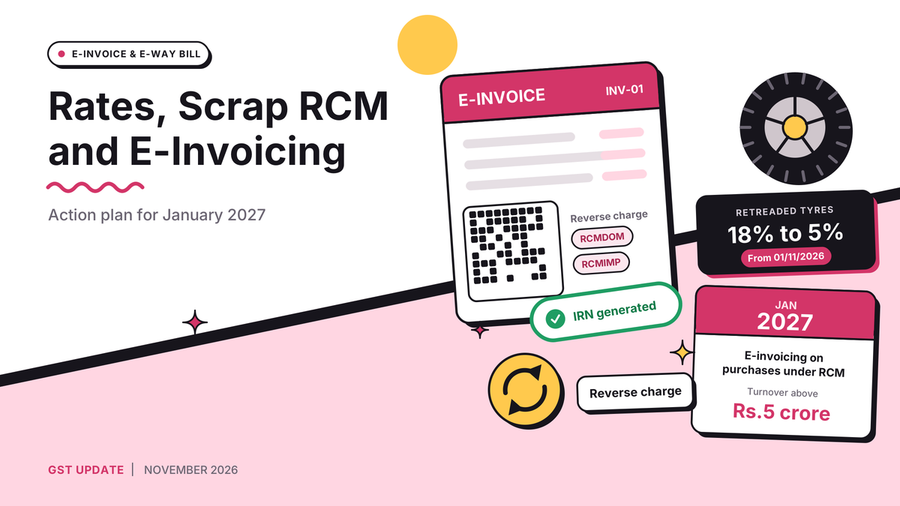
In short: taxpayers with aggregate turnover above Rs.5 crore must e-invoice reverse charge purchases and import of services from 01/01/2027. The article also covers the wider scrap package, specific rate and exemption changes, and Instruction 02/2026-GST.
If your aggregate turnover is above Rs.5 crore, e-invoicing now reaches the purchase side from 01/01/2027. This update explains the new requirement, the wider scrap package, the specific rate and exemption changes from 01/11/2026 and Instruction 02/2026-GST.
What Has and Has Not Changed
The GST slab structure and general rates are unchanged. The 57th GST Council meeting, held on 08/10/2026, did not recommend any change to GST rates. What has been notified from 01/11/2026 changes only specific entries: a few goods, a wider scrap package, same-line ITC for the 5 per cent service categories, a handful of exemptions and the closing of long-running classification disputes. The notifications are Nos. 02/2026 to 10/2026-Central Tax (Rate) dated 27/10/2026, with Circulars No. 265 and 266 dated 28/10/2026. The e-invoicing notification below is in a separate series, Central Tax.
E-Invoicing Extends to the Purchase Side from 01/01/2027
Under Notification No. 04/2026-Central Tax dated 26/10/2026, taxpayers with aggregate turnover above Rs.5 crore must also generate e-invoices for purchases from unregistered persons where tax is payable under reverse charge, and for import of services. New INV-01 document codes are RCMDOM (domestic reverse charge), RCMIMP (import of services), SEZWPA and SEZWPNA (SEZ supplies with payment, for authorised and non-authorised operations). ERP and GSP set-ups need to be updated before the first January 2027 document.
If your ERP is SAP, Oracle, Dynamics or Tally, check that the e-invoicing connector is updated for the new document codes. WhiteBooks offers the SAP, Oracle, Dynamics and Tally e-invoicing connectors.
The Scrap Package
Used cooking oil, plastic scrap, tyre scrap and e-waste join metal scrap. Where the supplier is unregistered, reverse charge applies on the registered buyer. Where the supplier is registered, the registered buyer deducts TDS at 2 per cent. Suppliers of these five categories lose the registration exemption for reverse-charge-only supplies and must register on crossing the threshold.
Goods
- Retreaded tractor tyres move from 18 per cent to 5 per cent.
- Sea-weed extract bio-stimulants registered under the Fertiliser (Control) Order are taxed at 5 per cent as fertilisers, and the past period is regularised.
- Psyllium seeds (Isabgol) are exempt.
- All toys under heading 9503 are at 5 per cent (18 per cent for electronic toys), and sublimation paper under 4809 is at 18 per cent.
Services and Exemptions
- Hotels, outdoor catering, restaurants and railway catering at 5 per cent: ITC is now allowed on the same-line input service, capped at 5 per cent.
- Electric vehicles: passenger transport and renting (passengers and goods) at 5 per cent without ITC or 18 per cent with ITC.
- Delivery services through e-commerce operators: 5 per cent without ITC, with the operator paying under Section 9(5) where the delivery person is not liable to register.
- GTA and transport exemptions are withdrawn where the goods are supplied through an e-commerce operator, and the 5 per cent delivery entry applies.
- New exemptions include grant of toll collection rights by Government, Seamen's Provident Fund services and curing of coffee for cultivators.
Update your rate tables and HSN masters before the first affected invoice. Confirm each code with the free GST HSN and SAC code search and test the tax amount in the GST tax calculator.
Instruction 02/2026-GST from 30/10/2026
The instruction applies three of the Council's recommendations in CGST formations ahead of the amendment of the Act:
- Arrest: no further arrests under GST by CGST formations, pending omission of Section 69.
- E-way bill interception: a conveyance is intercepted only on specific intelligence authorised in writing by an officer not below Joint Commissioner. Inspection, detention or seizure is limited to cases where the supplier or recipient is registered or located in the intercepting officer's State. Where no e-way bill and no document of origin or destination is produced, action lies irrespective of jurisdiction. There is no confiscation under Section 130 of goods or conveyances in transit.
- Small demands: no show cause notice under Section 73, 74 or 74A where the amount involved is below Rs.10,000.
The instruction binds CGST officers only. A State intercepting officer continues under the existing Sections 68, 129 and 130 until the State issues a similar instruction.
Other Points
Goods moved by metro railway are brought within the railway e-way bill provisions (Rule 138(2A)). Rule 86(3) now debits the credit ledger for refunds in the order fixed by Rule 89(3): IGST first, then CGST and SGST equally.
How WhiteBooks Helps You Get Ready for 01/01/2027
WhiteBooks e-invoicing software is a GSP-integrated platform for generating IRNs, and its connectors and API work with the ERP you already use. Confirm with the WhiteBooks team that your set-up supports the new reverse charge and SEZ document codes before the first January 2027 document.
- Generate and manage IRNs, including bulk IRN generation, with one-click e-invoicing and review them in the IRN register.
- Integrate through the e-Invoice API if you run your own billing system.
- Record purchases from unregistered suppliers in purchase invoice management.
- Read the step-by-step e-Invoice IRN generation guide.

A3 Advisors LLP
A3 Advisors LLP is an entrepreneurial tax and business consulting firm led by Big 4 alumni. The firm offers holistic solutions across direct tax, transfer pricing, indirect tax, valuations, corporate law and virtual CFO services.