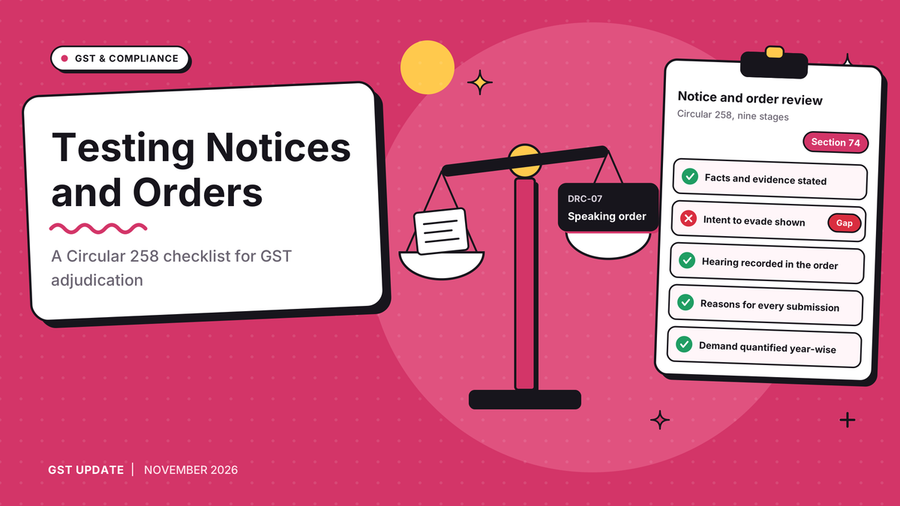
In short: Circular No. 258/04/2026-GST sets out what a valid notice, hearing and order must contain. Taxpayers can use its nine checkpoints below to test a notice or order before replying or appealing.
An order can fall on procedure even when the demand looks large. Circular No. 258/04/2026-GST turns the rules on notices, hearings and orders into nine checkpoints you can use to review any notice or order before you reply or appeal.
Why a Procedural Checklist Matters
An order can be set aside or remanded if it is non-speaking, ignores the reply or invokes fraud mechanically. Circular No. 258/04/2026-GST dated 26/10/2026 lays down, stage by stage, what a notice must contain, how hearings are conducted and what a speaking order looks like. It draws on the Supreme Court in G.R. Infra Project Ltd. v. State of Madhya Pradesh.
The guidelines bind the officer but are not to be cited in notices or orders (paragraph 17). For a taxpayer, they work as a structured review checklist for a notice or order already received.
Section 73 and Section 74 in Brief
Section 73 and Section 74A(5)(i) cover demands without fraud. Section 74 and Section 74A(5)(ii) cover fraud, wilful misstatement or suppression, which is why the checkpoints below treat those provisions strictly.
The Nine Checkpoints
- Pre-notice intimation (DRC-01A Part A): issued wherever feasible before the notice, giving a chance to pay or explain. From 01/04/2027 it names the earlier proceeding.
- Show cause notice (DRC-01 summary): facts and evidence stated as "it appears that", the provision linked to each act, the demand quantified year-wise, and the authority and reply date stated. A notice that reproduces the sections without facts, or is cured later, does not survive.
- Fraud, wilful misstatement or suppression (Section 74 and Section 74A(5)(ii)): only where the notice sets out material evidence of intent to evade. Not for mere non-payment, a scrutiny discrepancy or a difference of interpretation. A later-period notice on the same facts goes under Section 73.
- No parallel proceedings (Section 6): once the State officer has initiated proceedings on a subject matter, the Central officer does not, and vice versa.
- Reply and hearing (DRC-06 and Section 75(4)): a hearing on request or where an adverse decision is contemplated, a maximum of four opportunities, refusal only with reasons, and a virtual hearing to be offered. Each hearing is recorded in the order, a fresh hearing is needed where the officer changes, and the order is preferably passed within one month.
- Adjudication order (DRC-07): a speaking order that frames the issues, analyses the evidence, accepts or rejects each submission with reasons and discusses the case law of both sides. "The reply has been considered" is not enough. Findings are confined to the notice (Section 75(7)), with year-wise and issue-wise quantification and payments appropriated.
- Extended period in the order: where the notice lacks evidence of intent, the officer records that finding and confines the demand to Section 73 or Section 74A(5)(i).
- Rectification (Section 161 and DRC-08): only by the issuing authority, within three months of the application and six months of the order, and only for errors apparent on the face of the record. It is not a substitute for appeal.
- First appeal (APL-01 and APL-04): limitation is decided first with reasons, being three months with one further month condonable. Merits are not rejected at registration. Additional grounds and evidence are allowed only on the Rule 112 conditions, and the decision is to be given within one year as far as possible.
Revised Forms from 01/04/2027
From 01/04/2027 the DRC-01 summary selects the ground from a list of 22 standard grounds and names the earlier proceeding. A notice whose summary ground does not match the body can be questioned. Revised DRC-01 and DRC-07 apply from the same date.
Appeals Are Covered Too
The guidelines apply to the Appellate Authority as well (paragraph 16). An appellate order that does not deal with each ground and each judgment cited is equally open to challenge before the Tribunal.
How WhiteBooks Helps You Track and Respond to Notices
A procedural review is only useful if you see the notice in time. WhiteBooks GST notice management software brings notices into a single dashboard so deadlines are not missed.
- Track deadlines and liability for every notice, and review the Notice Summary, Overdue Notices and Financial Exposure reports.
- Build the factual basis for a reply by reconciling ITC with GSTR-2B reconciliation and reviewing GST compliance reports.
- Draft replies in-app. The AI-assisted drafter speeds up the first draft, but a qualified professional should review every reply before it is filed.

A3 Advisors LLP
A3 Advisors LLP is an entrepreneurial tax and business consulting firm led by Big 4 alumni. The firm offers holistic solutions across direct tax, transfer pricing, indirect tax, valuations, corporate law and virtual CFO services.