In short: Circular No. 257/03/2026-GST lists the accepted proof for each type of premises, sets a 7-working-day track (Aadhaar authenticated) and a 30-day track, and limits officer queries to three grounds. Find your type of premises below and keep the matching annexure ready.
Applying for GST registration? The right address proof for your type of premises decides whether the application clears on the first filing. Use the list below to match your premises to the accepted documents and the time limit that applies.
Why New Applications Stall on Address Proof
Queries over the proof of the principal place of business can hold up a new GST application, and applicants can be asked for papers the law does not require. Circular No. 257/03/2026-GST dated 26/10/2026 lists, premises by premises, the documents that are accepted and the formats to use, so the application can go through on the first filing.
Accepted Proof by Type of Premises
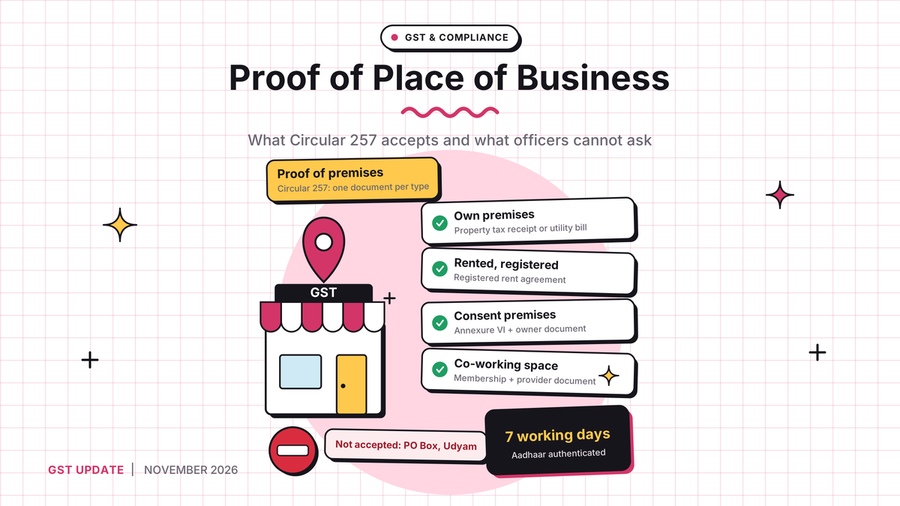
- Own premises: any one of the latest property tax receipt, municipal khata, property ID document, or latest electricity or water bill in the applicant's name with the full address. Premises in a parent's, spouse's, partner's or director's name are not "own"; select consent, rented or shared instead.
- Deceased ancestor's name: death certificate, an affidavit on stamp paper of the minimum value (Annexure IV) that the applicant is the successor in possession, and one ownership document.
- Rented with a registered agreement: a clear copy of the agreement is enough. Where State law requires registration for the use or the period, only a registered deed is accepted.
- Rented with an unregistered agreement: the agreement plus one ownership document in the landlord's name. Where the electricity or water connection is in the tenant's name, the tenant's latest bill with the agreement is accepted instead.
- No rent agreement: an undertaking in Annexure V and a document showing the tenant's possession, such as the latest utility bill in the tenant's name.
- Consent premises: a consent letter in Annexure VI on plain paper signed by the owner, plus one ownership document in the owner's name. Where the premises are co-owned, the consent of all co-owners is needed.
- Joint ownership: no consent or NOC from the other co-owners is needed. Where the bills are in another co-owner's name, upload a document showing both names as owners.
- Co-working space: the membership agreement showing the period and the specific suite, cabin or desk, plus the provider's ownership document or the registered lease between the provider and the owner.
- SEZ unit or developer: the Letter of Approval or Permission with validity. A separate registration is mandatory even where a non-SEZ GSTIN exists in the same State.
- Shared electricity meter: with a registered agreement nothing more is needed; with an unregistered agreement, one document in the landlord's name is added.
Not accepted as proof: a Post Office Box or courier address, photographs of the applicant or landlord, a Udyam or MSME certificate, and documents that are old, cropped, partial or illegible.
Time Limits Under Rule 9
- Aadhaar authenticated: 7 working days.
- Aadhaar not authenticated, or flagged for physical verification: 30 days.
- Rule 14A and Rule 9A applications approved by the system: 3 working days.
- No action within the time limit means the application is deemed approved.
What an Officer May and May Not Ask
An officer may raise a query only where a document is incomplete or illegible, where the address does not match the document or the document is not a valid proof of that address, or where the address is incomplete or vague. An officer may not ask why the residential address is in another city or State, ask for a Udyam or MSME certificate, question whether the declared activity can be carried on from the premises, or ask whether the electricity connection is domestic or commercial.
Other Points to Note
- A bank account is not needed at the time of application. It is added within 30 days of registration or before the first GSTR-1 or IFF, whichever is earlier, in the applicant's name, against the applicant's PAN.
- Opting for Aadhaar authentication moves the application from the 30-day track to the 7-working-day track.
- A query outside the three permitted grounds can be answered by citing paras 5.4 and 5.4.1 of the circular. The time limit still runs.
- Delay or unwarranted queries may be reported to the Chief Commissioner or State Commissioner on the e-mail notified for the purpose.
After Registration: First Steps
Once the GSTIN is issued, confirm the details on the portal with the free GST number search and GSTIN verification tool and set up your billing with GST sales invoices in WhiteBooks accounting software. Use the GST HSN and SAC code search to pick the right code and rate for each item you sell.
How WhiteBooks Helps From Registration to First Return
Registration is the first step of a longer compliance cycle. WhiteBooks supports the steps that follow it.
- Need help with the application itself? WhiteBooks registration and compliance services cover GST registration and ongoing filings.
- Raise invoices and prepare returns in one workspace with WhiteBooks GST software.
- Move to e-invoicing when your turnover requires it with e-invoicing software.

A3 Advisors LLP
A3 Advisors LLP is an entrepreneurial tax and business consulting firm led by Big 4 alumni. The firm offers holistic solutions across direct tax, transfer pricing, indirect tax, valuations, corporate law and virtual CFO services.